Purpose: Provide safe dental treatment throughout pregnancy for the patient and the pregnant dental professional. Oral health is an important component of general health and should be maintained during pregnancy and throughout a woman’s lifespan.
Treatment
Patient: General dental care, including but not limited to routine treatment, radiographs, and local anesthesia (with and without epinephrine), is considered safe at any point during pregnancy. Emergency treatment, such as extractions and root canals, can be safely performed during pregnancy. More complex cases that involve general surgery should be delayed until after delivery. 1,3,4 Use clinical judgement at the discretion of supervising faculty
-
Recommended questions before treatment
-
Expected delivery date
-
Is this a high-risk pregnancy? If yes
-
Consult with an obstetrician before dental treatment
Considerations
Radiation (x-rays)
-
Patient: Radiographs are considered safe for the pregnant patient, at any stage during pregnancy; shielding (abdominal or thyroid) is no longer recommended.
-
Dental Professional: recommended that operators of radiographic equipment who are pregnant firmly adhere to shielding procedures as specified in the facility’s radiation protection program.6. Optional to complete the Pregnancy declaration form, OUHSC Radiation Safety Office. Send completed forms to kim-graziano@ou.edu.
Pregnancy Radiation Declaration form
Nitrous Oxide
-
Patient: Nitrous oxide is not recommended because there is a risk of fetal harm if administered during pregnancy. Emergency/medically necessary cases; there is no evidence that in utero human exposure to anesthetic or sedative drugs has any effect on the developing fetal brain. Recommend limited exposures, < 3 hours in duration, at a lower dose ~30% nitrous oxide. 3
-
Dental Professional: It is recommended that pregnant individuals avoid exposure to nitrous oxide.2,5
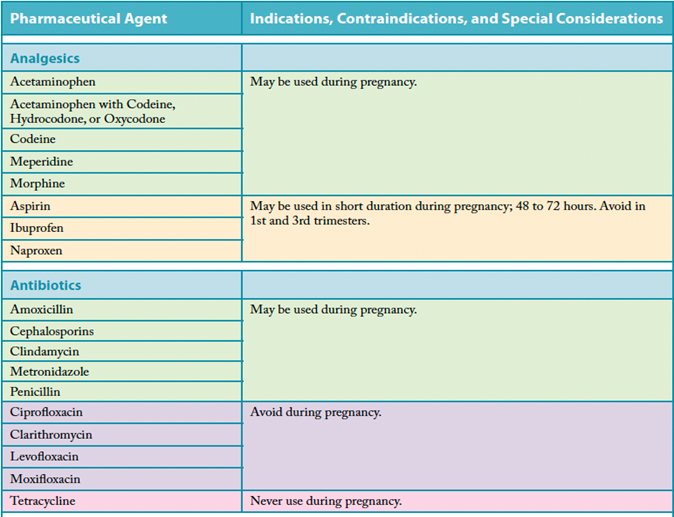
Pharmacological Considerations for Pregnant Women1


References:
-
Oral Health Care During Pregnancy Expert Workgroup. 2012. Oral Health Care During Pregnancy: A National Consensus Statement. Washington, DC: national Maternal and Child Oral Health Resource Center.
-
National Institutes of Safety and Health NIOSH: Control of Nitrous Oxide in Dental Operatories. Publication number 96-107
-
American College of Obstetricians and Gynecologists Committee on Obstetric Practice and the American Society of Anesthesiologists. Nonobstetric Surgery During Pregnancy (Number 775). 2017; Reaffirmed 2021. https://www.acog.org/clinical/clinical-guidance/committee-opinion/articles/2019/04/nonobstetric-surgery-during-pregnancy. Accessed September 11, 2025.
-
American Dental Association; ADA Resource Library Pregnancy
-
Nitrous Oxide Safety for Pregnant Dental Staff and Patients Guidelines for Practice Success Managing Pregnancy | Business Operations. https://www.ada.org/resources/practice/practice-management/nitrous-oxide-safety-for-pregnant-dental-staff-and-patients
-
Benavides E, Krecioch JR, Connolly RT, et al. Optimizing radiation safety in dentistry: Clinical recommendations and regulatory considerations. J Am Dent Assoc 2024;155(4):280-93 e4.